Butterfly Of The Month: August – The Gatekeeper

the-gatekeeper

Peter Martin writes:

Due to its habit of frequenting hedgerows, this butterfly was, at one time, known as the “Hedge Brown”. In even earlier years, it was called “Hedge Eye” and also “Small Meadow Brown”.

Depending upon the weather, the first butterflies usually begin to emerge from their chrysalides during mid-July, but August is the month when I have seen the greatest number. They are fairly common and the best place for seeing them at Fleet Pond Nature Reserve is probably between the Dry Heath and the Railway.

Ragwort, Fleabane, Marjoram and Buddleia are good nectar sources, as this butterfly’s proboscis is fairly short, but its favourite is probably Bramble.

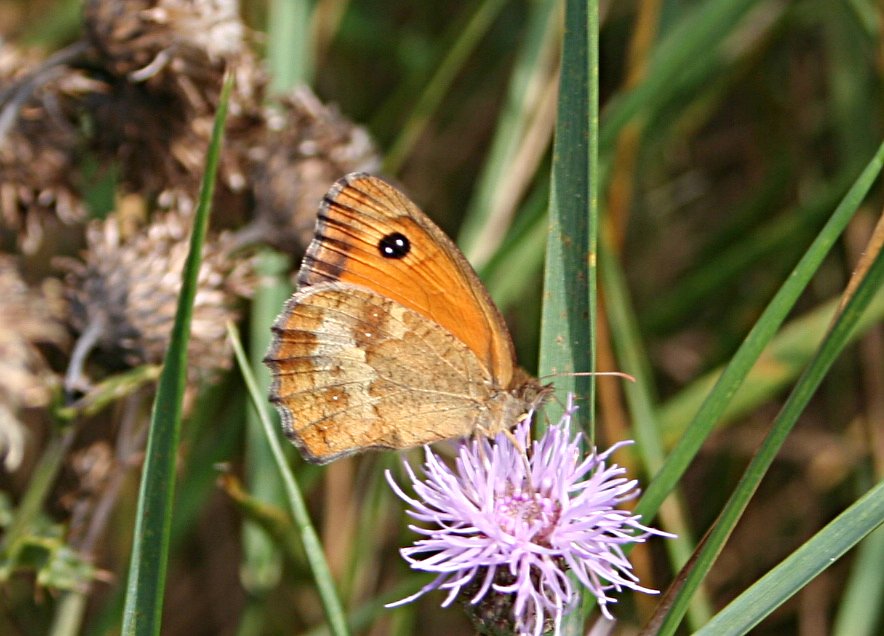
The Gatekeeper is not difficult to identify. Smaller than the Meadow Brown, its uppersides are orange, with dark brown borders and dark “eye” spots on each wing. Males also have brown bands of scent scales across the orange patches on their forewings. The underside orange forewings have “eye” spots and brown borders, with hindwings being varying shades of brown.

The pale eggs, which are laid singly during August among loose grasses and in shady places under shrub canopies, gradually become mottled and then brown. Light brown caterpillars, with darker stripes, emerge after about three weeks and, after eating part of their eggshells, they nibble tender shoots of Common Couch or other grasses. They hibernate after making the first of four skin changes and resume eating in the spring. The tender grass tips are nibbled at dusk so, if you want to see them, a torch may be needed. They pupate during June.

If you see Gatekeepers well into September, completion of their life cycle may have been delayed by a wet summer!

Picture credit here.


Butterfly Of The Month: July – The Small Tortoiseshell

small-tortoiseshell

Apologies, I’m a little late in putting this one up!

Peter Martin writes:

If you have seen Small Tortoiseshell butterflies earlier in the year, they will have been the ones that have flown after winter hibernation and may have, therefore, been damaged and rather less colourful that those that you see in July.

The females will have laid 60 to 100 eggs on the tender leaves of Stinging Nettles, growing in sunny spots, early in May. These will have hatched out after about 10 to 14 days and you may have seen the dense silken webs that the black and yellow caterpillars spun around the leaf tips to live communally until they made their last skin change. Some of the beautiful gold or brown chrysalides have been found as far as 60 yards away from the nearest nettles, suspended from other plants or materials.

A few butterflies from this generation may emerge towards the end of June, but July is the month to watch out for them, You may come across the Small Tortoiseshell almost anywhere, with so many patches of Stinging Nettles being left in sunny spots by the “conservation-minded”.

Their upper wings have a mixture of orange, yellow and black, with dark edges usually showing some blue. The underside forewings are lighter than the hindwings, which provide a darker camouflage when the butterflies are resting with their wings closed. When open, their wingspan is about 45 mm (1.8 inches). You may see them posing with their wings open, whilst nectaring on Devil’s Bit Scabious, Field Scabious, Small Scabious or other flowers. The over-wintering generation, which flies from late August onwards, often nectar on Hemp Agrimony, Buddleia, Michaelmas Daisies and Sedum.

In Scotland, in the past, the Small Tortoiseshell has been known as the “Devil’s butterfly” or the “Witches butterfly”. People in other parts of the British Isles have called them the “Tortoiseshell fly” or the “Nettle Tortoiseshell”.

Small Tortoiseshell butterflies were once very common, but I have seen very few in the last few years. The reason for this is that a parasitic fly called Sturmia bella lays its eggs on nettle leaves and, unwittingly, these are consumed by the caterpillars, which are then eaten by the emerging fly grubs at this or the chrysalis stage.

Butterfly Conservation and Oxford University have started a research project to investigate whether Sturmia bella is the main reason for the butterfly’s decline. Initial results have revealed that, at least in the southern half of the UK, 60% of the caterpillars were killed wherever it was present.

Picture credit here.


July Wildflower Watch – Heather, Lichen, Meadowsweet and Yellow Loosestrife

Painted Lady butterfly on Bell heather at Dry Heath

Michelle Salter writes:

Walking through the Dry Heath, I took the above photo of a Painted Lady butterfly resting on one of the many patches of purple Bell heather currently in flower there. Native to dry heathland, Bell heather is an evergreen shrub that is attractive to a wide range of insects, including bees and butterflies.

Lichen on Dry Heath
Lichen on Dry Heath

Growing in spongy tufts between the swathes of colourful heather is bushy lichen. Commonly found in drier areas of heathland, the pale green stems make a stark contrast to the rich colours of the surrounding heather.

Meadowsweet by railway station carpark footpath

The foamy flowers of Meadowsweet are currently on display at the edge of the pond alongside the station car park. A member of the rose family; the creamy white clusters of flowers have a strong, almond-like fragrance and were once used to sweeten honey wine.

Yellow Loosestrife by Hemelite Bay jetty

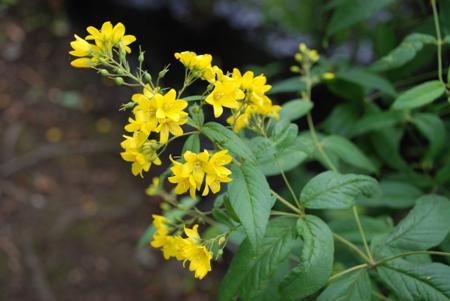
There are always plenty of wildflowers to be found along the stretch of footpath parallel to the railway line, and the golden flowers of Yellow loosestrife are presently adding splashes of colour to the water’s edge. Found in moist habitats such as marshes, fens and stream sides, the spikes of yellow flowers provide a plentiful supply of pollen for bees.

Photo credits: Michelle Salter


Happy Birthday Blog!

Fleet Pond blog was started on 23 July 2008, so now it’s time to celebrate running for one year!

Many thanks to all our contributors and readers for making the blog such a big success.

As a reminder, here’s a selection of photos from the past year:

Air Ambulance at Sandy Bay

f08-eli-lilly

benson-small

a1940-drained-pond-1940-1

blackie-2

Kenilworth Viewpoint - After

summer grazing sm

young budding driver

Grasmere
Grasmere
Wild Honeysuckle
Wild Honeysuckle

carnival 2009 terry

DSC_1491.25%


Five Fleet Friars Float

Fleet Carnival 3rd Place

Nick Keeley writes:

At the start of June we committed ourselves to enter a Fleet Pond Society float into the Fleet Carnival Parade.  The theme was “Food, Glorious Food” and we quickly linked this to Fleet Pond’s history as the provider of fish to the monks of Winchester in the Middle Ages.

This would involve us dressing as monks. Were we to be monks or friars? Monks, of course, but friars provided the alliterative heading to this blog.

That was the easy bit done, but how to make it happen? Beth would make and paint some brightly-coloured fish and Mandy would acquire the monk costumes.  Terry, Nick and Geoff built the float.

DSC_1463.25%

Geoff, Beth, Mandy, Nick, Colin, Terry, Cathy and Thura

A very sturdy A-frame was built to fit it to the trailer and Nick spent many hours trying to restore a couple of very old four foot square paintings of the pond only to have his efforts rejected whilst he was away on holiday! Decades of grime had left them looking rather drab even after cleaning and varnishing, so two of Colin’s photographs of the pond were made into four foot square posters, which should also be useful for future promotional events.

These posters were generously provided at less than half price by Colin Povey of A Team printers.  Colin got another poster (with another generous 17% discount from Fuji) explaining the Pond/monks connection, just so as to ruin any rear-view vision the tractor driver might have had.

Emails soon promoted us to being a sub-committee. Perhaps we should have been a sub-cloister, as we would not be senior enough to be a sub-conclave.

carnival 2009 terry

Terry The Tractor Driver

The day before the Carnival, Terry, Colin, Nick and Geoff met up to decorate the float with appropriate foliage.  Terry, our tractor driver, took the completed float for a test run and mastered the art of reversing in a matter of seconds. He was probably helped by his past military flying career, when it helped to approach from an angle that nobody expected.

Carnival day arrived and Beth’s colourful fishes provided the finishing touch.  More volunteers turned up to help collect donations and hand out sweets to the watching children. We were also pleased to find that, despite being a very small float surrounded by very large lorries, we had won third prize in the Private Entry Section.

DSC_1491.25%

Merrymaking Monks!

Off we set in the Carnival parade, and when we had a spare moment we were already working out our plans for next year’s float.  The drizzly rain held off until we were approaching the Views, where the parade ended.

Mindful that the Carnival sub-cloister had not actually had a synod the five monks headed for one of the fairground rides, which hurled us up into the air and was not really ideal for a meeting. Finally four of the monks got soaked going down a rather high kiddies’ slide.

Terry had the job of taking the tractor and trailer back to the workshop and that was the end of our Carnival, apart from dismantling the float next morning.

Beth, Geoff, Mandy, Nick, Terry were the famous five.

DSC_1561.25%

It’s A Long Way Down!

Photo credits: Michelle Salter and Colin Gray.