Volunteer Event This Sunday!

Fleet Pond Society organises and runs a series of volunteer conservation activities at the Pond. The next conservation task is this coming Sunday, November 9.

If you have never been before and fancy trying it, please just turn up (details here) or else give Colin Gray a call on 01252 616183, who will be delighted to provide additional information.

Speaking from personal experience, new volunteers are made very welcome and there is a very nice friendly atmosphere overall. Tools and advice are available – you even get tea/coffee and cakes in the mid-morning break!

Interestingly the volunteers have a very wide range of ages, backgrounds and interests. To give a flavour of this, we will occasionally provide ’spotlights’ on volunteers to explain their motivations for getting involved and what they get out of it.

Hopefully this will be an additional motivation to readers of the blog to come along and give it a go – it’s a very rewarding way of spending a Sunday morning!

Further information on volunteer events and ‘spotlight’ volunteers can be found by searching this blog.


Keep An Eye Out For Different Types of Bees!

solitary-bee

Colin Gray writes:

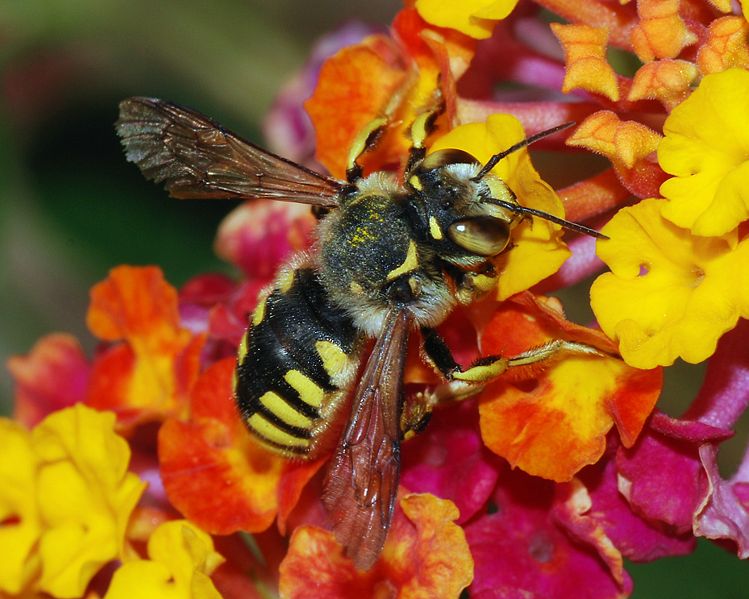
Solitary Bees
Did you know that Britain has more than 250 species of native bee? All of these bees play an essential role by pollinating flowers. But these bees are becoming scarce, with fewer wild flowers and suitable nest sites and an increase in pesticide use. Now around 25 per cent of our native bees are listed as endangered species.

Out of these 250 species, over 90% of them are solitary bees. By solitary we mean that a single female, after she emerges from her pupae and is mated by a male, constructs, provisions and lays an egg in each cell in a nest by herself. This in comparison with social (called eusocial) bees like the Bumble Bees, Honey Bees and Stingless Bees, all of whom have a Queen who lays eggs and a number of workers who look after them.

Female solitary bees prepare their own nest in the ground, in cracks or crevices in walls, or in wood. They gather nectar and pollen as food for their own offspring, and provide little or no further care after their eggs are laid.

Solitary bees come in many different sizes, colours and shapes. Common solitary bees are mason bees, miner bees, sweat bees, wool-carding bees and carpenter bees. They vary in colour from basic black to bright metallic green, blue or red. Some solitary bees superficially resemble wasps.

Solitary bee picture credit here.

Leafcutting and Mason Bees, collectively called megachilids (pronounced mega kyle’ lids)
leaf-cutter-bee

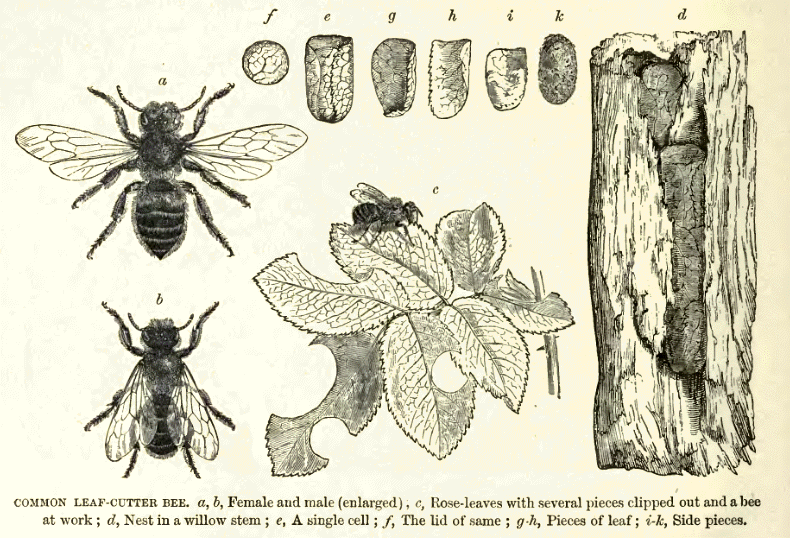
Leafcutter bees nest in soft, rotted wood, thick-stemmed pithy plants such as roses and in similar materials that the bees can easily cut through and excavate. Nest tunnels may extend several inches deep and coarse sawdust is thrown out at the entrance.

After the nest has been produced, leafcutter bees collect fragments of leaves to construct individual nest cells. The bees cut leaves in a very distinctive manner, making a smooth semicircular cut about 3/4-in in diameter from the edge of leaves.

These are carried back to the nest and used to fashion nest cells within the previously constructed tunnels. Each leaf-lined cell is then provisioned with a mixture of nectar and pollen. An egg is then laid and the cell sealed, producing a finished nest cell that somewhat resembles a cigar butt.

A series of closely packed cells are produced in sequence so that a finished nest tunnel may contain a dozen or more cells forming a tube 10cm to 20cm long. The young bees develop and remain within the cells, emerging the next season. Leaf-cutter bees differ from related species in that they collect pollen on their abdomens rather than on their hind legs.

Leaf-cutter bee picture credit here.

Colin produced the above written material for use in Fleet Library as part of their National Insect Week exhibition this year.


Five Fascinating Fleet Pond Facts

Michelle Salter writes:

How old is the pond? The first clear reference to the pond was in the 14th century, when “the great fishery (of) Fleet Ponds” is referred to in the Rolls of Account of Crondall Manor. By this time, there seems to have been a thriving fishery of considerable importance and two ponds.

Do any museums house records of the pond? Many Victorian naturalists visited Fleet Pond and references to its flora frequently appeared in natural history journals from this era, with herbarium sheets located at the Natural History Museum in Kensington and also at Reading and Oxford.

When was the pond used as an ice rink? In the 1840’s, the South Western Railway ran special excursions to Fleet Pond, including a “Skating Specials” in the Winter.

When was the pond, not a pond? In 1940, the MOD completely drained the pond to stop hostile bombers from using it as a landmark to find the Royal Aircraft Establishment at Farnborough (see photo above).

What title did the pond receive in 1951? The pond was designated a Site of Special Scientific Interest in 1951 and was one of the first sites in Hampshire to receive this distinction, due to the importance of the lake to waterfowl and the rich aquatic and heathland flora.


Fishing At Fleet Pond

Fleet Pond is the largest fresh water lake in Hampshire and the nature reserve has 54.6 hectares (135 acres) of varied habitats for the enjoyment of the local community. The pond itself occupies about half this area. The picturesque 21.4 hectare (53 acre) water was recorded in Saxon times as “Fugelmere” and supplied fish to the monks of St. Swithins (now the Cathedral) at Winchester.

Unfortunately in the past 25 years Fleet Pond has become very shallow due to large amounts of sand silting it up, with a depth of only 16″ right across the pond. Fishing and boating is allowed during the period between 16th June to 14th March. Fishing is only from 6 swims (namely, particularly good places for fishing) along the railway bank and one at the bottom of Chessnut Grove Rd. All the platforms have recently been given a facelift and provide improved comfort thanks to the Fleet Pond Ranger!.

Typical fish stocks are: perch and hybrids up to 2lbs, tench up to 4lbs, bream up to 5lbs, carp up to 10lbs, roach and rudd up to 11.5 lbs and pike up to 18 lbs.

Picture: Common Carp, credit here.

To fish at Fleet Pond a permit from Hart District Council is required. These are available from the reception desk in The Harlington Centre, or ‘Tackle Up’ on Fleet Road. Also required is an Environment Agency rod licence which is available from the Post Office or the Environment Agency website. Fishing is only from a boat or an approved fishing jetty, site by-laws apply.

The top picture is taken from an article in The Independent in March 2008, which includes the interesting statement that “If your home is where Hart is – well, lucky you. It is a tranquil corner of Hampshire where the statistics suggest that the quality of life is higher than anywhere else in the country”.

Please also see here.


Ranger’s Notebook – Tern Islands

Joanna Lawrence, The Fleet Pond Ranger, writes:

Earlier this year, Fleet Pond Society and Hart’s Countryside Service together purchased two tern islands. These artificial islands, made from 100% recycled plastic, provide the terns who visit the Pond with somewhere to nest.


Common terns (pictured above, picture credit here) are summer visitors to Britain and the rest of Europe, spending winters in the tropical regions of West Africa. They arrive here in April to breed, and feed on fish and crustaceans.

The islands at the Pond are filled with gravel which the terns create small depressions in, line with soft material, and lay their eggs. The clear plastic walls around the island prevent any predators getting to the chicks.

The good news is that these islands have already been used this summer by a few pairs of terns, despite only being put out on the Pond in June. This is very encouraging news means that next year we expect even more of these birds to be using the islands to rear their chicks.