All posts by David Pottinger

Migrants Flocking At The Pond

reedwarbler09

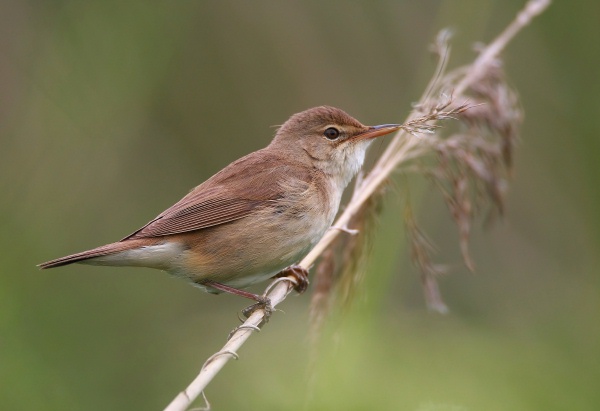
Picture: Reed Warbler

From The Independent:

Tot it up. Buds are bursting. Leaves are opening. Blossom is blooming. Flowers are flourishing. Butterflies are emerging. Trout are rising. Birds are singing. Birds are nesting. And indeed, birds are arriving. The arrival of the migrant birds that winter in Africa and spend the summer breeding in Britain is perhaps the most exhilarating April event of all… it has been estimated that (before the declines began) as many as four million willow warblers alone landed in Britain every spring – four million pairs of tiny whirring wings crossing the Sahara, the Mediterranean, Spain and France and finally the Channel before fanning out across the land to begin their silvery descending songs.

For Fleet Pond specifically, we have had as many as 40 breeding pairs of Reed Warbler in the reedbeds. This bird is the one the cuckoos need at the pond because they are the cuckoos’ favourite for nests.  They can watch the birds building nests in the reeds from the trees and then drop in and lay as soon as a few eggs have been laid (see picture below).

reed_warbler_cuckoo

Picture: Reed Warbler Raising the Young of A Common Cuckoo

Also keep an eye out for house martins and swifts.  Nothing says spring more than a flock of swifts screaming their welcomes overhead.

swift in flight small

Picture: Swift in Flight

Picture credits: here, here and here.

Lions To The Rescue

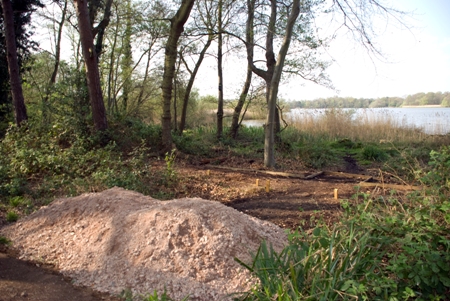
Kenilworth Viewpoint - Before
Kenilworth Viewpoint – Before

Michelle Salter writes:

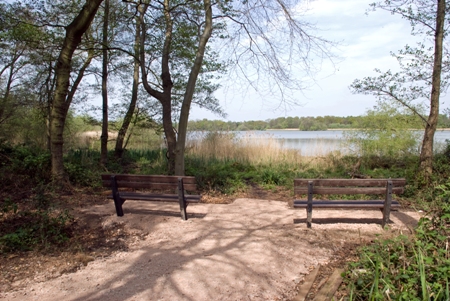
New benches, made from recycled plastic bags, had been donated to the Pond, with two earmarked for use at Kenilworth Viewpoint. This is a beautiful spot, which offers a wonderful view of the pond before the footpath takes you off into woodland. We wanted to install the benches at the earliest opportunity, so visitors could enjoy them during the summer months, but lacked the manpower – until Fleet Lions came to our rescue.

Jim Storey, Lions President, rounded up the troops and soon had a team willing to give up their Sunday morning lie-in and take on the task. A few of us did a recce of the site a couple of days beforehand and found the Rangers had already dumped a large pile of gravel for our use and outlined the proposed path edge and position of the seats. As well as assembling and installing the benches, we discovered we also needed to raise the level of the ground around the seating area and of the path leading down to it, making it suitable for prams and wheelchairs.

This was going to be quite a task, so we roped in a few volunteers from our regular conservation volunteer work party to lend a hand.

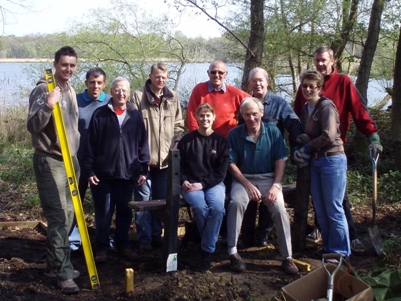
Graham, Richard, Nick, Keith, Michelle, Graham, Terry, Jim, Nikki & Mike

Ten of us met up at the workshop on the morning of Sunday 19th April and loaded up the tractor with all the parts needed to assemble the benches. On site, there was much scratching of heads as we tried to figure out the instructions. The benches didn’t need anchors as they were already part of the assembly (there is a T-shape on the lower end of the legs that is sunk into the soil), but a very deep hole was needed to make them secure.

We divided into two teams, with one half figuring out where all the nuts and bolts went and the other half on hole-digging duties. Once the benches were sunk into the ground more gravel was needed to level the area around them and raise the height of the access path. After many trips in the tractor to and from the workshop to obtain more rubble, and much shovelling of gravel into and out of the trailer, we eventually managed to create an even surface. Some flattening out with the manual and motorised tampers was needed to smooth out the ground before we were finally able to stand back and admire our handy work.

It was gratifying to receive appreciative comments from visitors to the pond that day, many of whom took the time to stop and thank us for the work we were doing. We hope that many more visitors will now stop to rest their feet at the Kenilworth Viewpoint and enjoy the scenery.

Kenilworth Viewpoint - After
Kenilworth Viewpoint – After

Read further details in the Star Courier, dated Thursday 30th April 2009.

Photo credits: Before and After: Michelle Salter and Group Photo: Vicki Jull.

Butterfly Of The Month: May – The Orange Tip

orange-tip-male

Peter Martin writes:

Although a few may have been seen during April, May is the month when there are often lots of Orange Tips flying around Fleet Pond. The footpath from Avondale Road alongside the Brookly Stream is often a good place to see them (see map on About page above). Like a large number of insects and animals, nature seems to make the male of the species more colourful and this is particularly true of the Orange Tip.

It is the male that has the splashes of orange on the upperside tips of the forewings. The female upperside is just white, apart from a black edging on the tips of the forewings. Underside hindwings of both sexes are a mottled green in colour. As females have no orange, they may be mistaken for Small Whites, or Green-veined Whites.

In some years, a few of the Orange Tip butterflies may be miniature – about half their normal size. The orange, lenticular-shaped eggs that are laid at the base of flower stalks on Cuckooflower or Garlic Mustard are unmistakable. As they are not much bigger than pin-heads, however, you may need a focus scope to really get a good view of them.

Before emergence, the colour of the eggs tends to pale and when the tiny caterpillars appear they may eat their eggshells, before turning their attention to the plants’ seed pods. As they grow, they may also eat the flowers and leaves and, as they are cannibalistic, even other caterpillars. After about 25 days, they pupate and, with their green hue and strange shape, the chrysalides closely resemble the seed pods of their food plants.

Orange Tips remain in the pupal cases until the following spring, when they emerge over a period of several weeks. It always seems a shame that such beautiful butterflies spend most of the year as egg, caterpillar and chrysalid, but each only flies for about 18 days. The first one recorded in my Fleet garden this year was a male seen on 19th April. If you have Honesty growing in your garden, the Orange Tip may lay its eggs on this plant.

To find out what butterfly will be featured next month, take a look at this blog in early June!

Peter Martin acted as author for a booklet entitled “Blackwater Valley Butterflies” which contains photographs of all 32 species found in this area together with information about their life cycles. Copies are available for £2.50 plus £1.00 p.p. from Blackwater Valley Countryside Partnership, Ash Lock Cottage, Government Road, Aldershot, Hants, GU11 2PS. (Cheques should be made payable to B.V.C.P.).

Picture credit here.

April Wildflower Watch – Marsh Marigold, Cuckoo Flower, Dog-violet and Forget-me-not

Marsh Marigold by Hemelite Bay

Michelle Salter writes:

Along the path from Boathouse Corner to Hemelite Bay, you will see the shiny, bright yellow petals of Marsh Marigold bringing bold splashes of colour to the edges of the pond. A member of the buttercup family, this ancient native plant, also known as Kingcups, May-bubbles, and Mollyblobs appears in early spring and is sometimes still in flower late into the summer months. Its sturdy, dark green, heart-shaped leaves offer shelter to frogs and other pond creatures.

Cuckoo flower by the Flash

Also making an appearance at Hemelite Bay, and on the banks of the smaller pond to the side, is the Cuckoo flower. Commonly known as Lady’s Smock, it has pretty, pink cupped or ‘frocked’ flowers. These pale blooms attract moths and early-flying butterflies such as the Orange-Tip, as well as bees and flies.

Forget-me-not on banks of Brookly Stream

Adding colour to the woods and along the banks of the Brookly Stream are masses of tiny Forget-me-nots. The five sky-blue petals of the Forget-me-not fuse at the base to form a very narrow tube and the five yellow scales form a ring at the entrance of this tube. The golden colour in the centre of the flower attracts pollinating insects and is a nectar source for early solitary bees.

Common Dog-violet alongside boardwalk to Sandy Bay

Common dog-violets are currently peeking out from under the boardwalks around the Gelvert Stream and Sandy Bay area. Unscented, these are one of the commonest violets and can be identified by the curved, paler spur at the back of the purple petals. The leaves of violets are a vital food source for the caterpillars of certain butterflies, particularly the Fritillaries, as they thrive for many months after the flowers have faded.

Next month, look out for Bogbean and the dreaded Skunk Cabbage.

Picture credits: Michelle Salter

FPS Photography Competition 2009 – All Welcome!

These photos (click to enlarge) won the (adult) Fleet Pond Society photography competition last year in their respective categories (Quiet Corners, Reflections and Shadows, and Shoots and Leaves).

Could you win this year?

Full details of how to enter this year’s competition are here (Word version) and here (pdf version).

The full set of winning and highly commended pictures for the 2008 competition (adult and under-16) are available here.